
☰ Read at your own depth: 1-MINUTE OVERVIEW | 3-MINUTE READ | FULL DETAIL
Last updated: May 29, 2026
1-MINUTE OVERVIEW
The outbreak and BE READY’s response
In early May 2026, a cluster of severe respiratory illness aboard the cruise ship MV Hondius was formally notified to WHO and ECDC. The causative agent was identified on 6 May as Andes hantavirus (ANDV), a rare but potentially fatal pathogen previously associated with South America.
BE READY, the European Partnership for Pandemic Preparedness, activated its cross-national coordination mechanisms within days. Drawing on its network of partners across 27 countries and the collaboration infrastructure built since January 2026, the partnership is now playing an active role in aligning European research priorities and supporting the international response.
This is precisely the scenario BE READY was designed for: a threat that emerges without warning, crosses borders rapidly, and requires a coordinated scientific response that no single country can mount alone.
3-MINUTE READ
The partnership’s response in detail
Aligning research priorities across Europe
On 22 May 2026, BE READY partners met online to initiate cross-country alignment of research priorities in response to the ANDV outbreak. A survey is currently open to collect partner input, mapping common priorities, gaps, and opportunities for coordination, as well as relevant national funding mechanisms.
This work is directly connected to the prioritisation effort being led by the WHO Collaborative Open Research Consortium (CORC) on Bunyavirales, the virus family to which ANDV belongs. BE READY’s involvement helps ensure consistency between European and international research responses.
The findings will also feed into the BE READY Pandemic Preparedness and Response Observatory, which tracks Research and Innovation efforts across EU Member States and Associated Countries.
Six research axes across the One Health spectrum
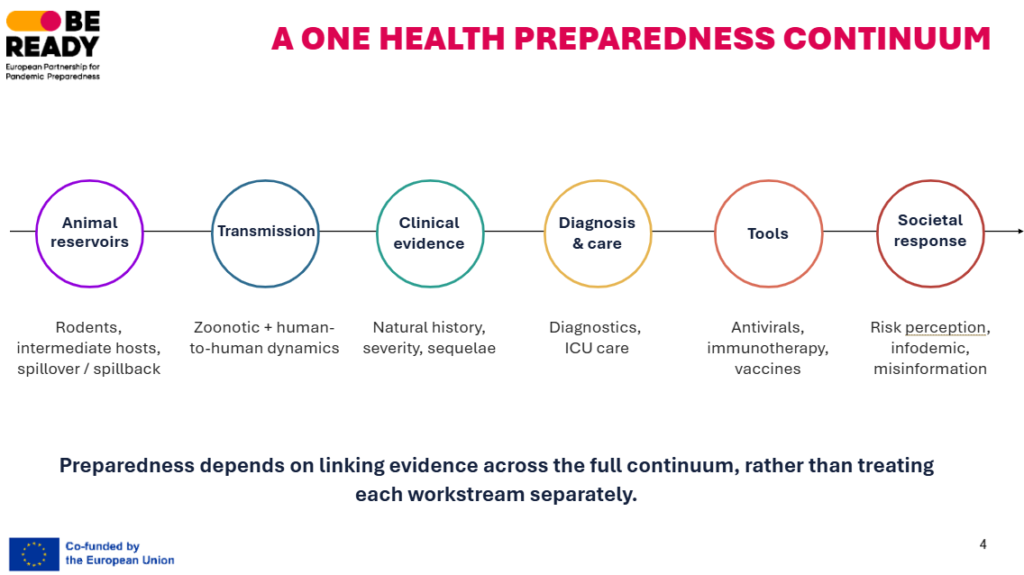
The partnership has identified six interconnected research workstreams that reflect BE READY’s One Health approach, integrating human, animal, and environmental dimensions: animal reservoirs, transmission dynamics, clinical evidence, diagnosis and care, tools development, and societal response.
Three working groups already active
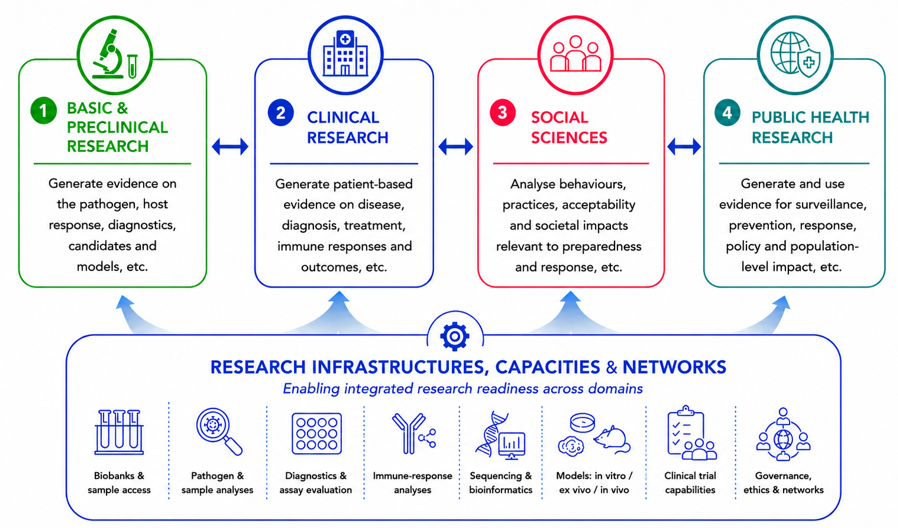
BE READY’s ever-warm research ecosystem means that when the ANDV outbreak emerged, dedicated working groups were already in place and could pivot rapidly to the new threat.
WP10 is conducting a mapping exercise to identify relevant preclinical capacities for hantavirus and ANDV across the partnership, including laboratory models, assays, and high-containment facilities. This work is being carried out in close collaboration with the European Medicines Agency (EMA).
WP11 is working with ECDC to support real-time, cross-country contact tracing, drawing on its network connecting public health, epidemiological, and social science expertise.
WP12 has been called upon to coordinate the NAVIS study, a prospective observational study on the natural history of Andes virus infection, based on an internationally harmonised protocol developed in coordination with WHO and ISARIC.
IN FULL DETAIL
Complete record: science, protocols and resources
The recent hantavirus outbreak on a cruise ship, linked to Orthohantavirus andesense (ANDV), highlights the continued threat posed by emerging and re-emerging diseases. This event underlines the importance of maintaining strong research preparedness capacities beyond high-profile pandemic threats.
BE READY is stepping up to respond to the Andes hantavirus outbreak
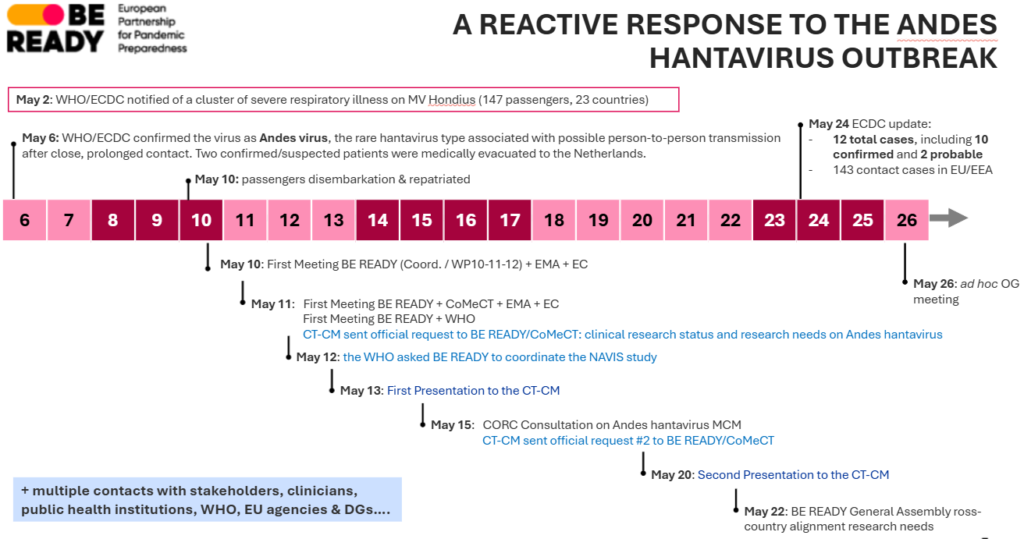
Formal WHO/ECDC notification of a cluster of severe respiratory illness aboard the MV Hondius occurred on 2 May 2026. On 6 May, the virus was identified as Andes hantavirus (ANDV).
BE READY, the European Partnership for Pandemic Preparedness, has been working closely with its European stakeholders since 10 May 2026, when passengers disembarked in Tenerife, Canary Islands, Spain. Drawing on the expertise of its 81 partners from 27 countries and the collaboration initiated in January 2026, BE READY is now playing an active role in coordinating the research responses to the ANDV outbreak.
BE READY Partnership aligns cross-national research priorities and funding mechanisms
On Friday 22 May, one hundred BE READY partners met online to initiate discussions on cross-country alignment of research priorities in response to the ANDV outbreak.
A survey is currently open to collect input from partners, which will lead to the identification of common and divergent priorities, gaps, and opportunities for coordination, as well as relevant national funding mechanisms.
The process is closely connected to the prioritisation work currently being undertaken by the WHO Collaborative Open Research Consortium (CORC) on Bunyavirales [link]. By ensuring consistency with WHO-led efforts, BE READY can help strengthen coherence between European and international research responses to the current ANDV situation.
In parallel, the information collected will feed into the Pandemic Preparedness and Response Observatory [link], a tool developed by BE READY to track and analyse Research & Innovation efforts in pandemic preparedness and response across EU Member States and Associated Countries.
Six research axes were identified
Preparedness depends on linking evidence across the full ‘One Health’ continuum. That is why six workstreams should be considered: animal reservoirs, transmission, clinical evidence, diagnosis & care, tools, and societal response.
BE READY implements an ever-warm research ecosystem
One of the pillars of BE READY is to set up a robust Research & Innovation ecosystem spanning the whole research spectrum. Three working groups (Work Package 10, WP11, and WP12) are part of this pillar. They contribute to BE READY’s response to the hantavirus situation.
An ever-warm Research and Innovation ecosystem
WP10 is working on preclinical research into ANDV
As there are currently no approved medical countermeasures specific to ANDV in the EU/EEA, preclinical work is of relevance for deploying a continued bench-to-bedside translational pipeline. BE READY WP10 is currently conducting a mapping pilot exercise to identify relevant hantavirus/ANDV preclinical capacities (including in vitro/ex vivo, animal, assay and high-containment capacities) and to assess if available virus/materials, assays, models and expertise can be matched to real-life research concerns. This work, in close collaboration with the European Medicines Agency (EMA), and linked to relevant consortia (NAVIPP, ISIDORe), will help strengthen the current armamentarium against ANDV.
WP11 collects social and public health data
The role of WP11 is to develop a network of networks in the fields of public health (PH) and social and human sciences (SHS), which will bring together epidemiological, behavioural, and societal insights from different countries and sectors in the event of an outbreak. In the context of the ANDV outbreak, BE READY is working closely with the European Centre for Disease Prevention and Control (ECDC) to ensure a real-time, consolidated contact tracing across countries.
WP12 avoids fragmented clinical research and launches the NAVIS study
Avoiding fragmentation of clinical research across countries is of paramount importance during an outbreak, especially considering human-to-human transmission of ANDV and reported cases.
The French ANRS Emerging Infectious Diseases (ANRS MIE), as coordinator of the BE READY Partnership, together with WP12 − in charge of an “ever-warm” clinical research network − was called upon to coordinate the NAVIS study (Natural History of Andes Virus Infection in a Shipboard Outbreak), based on the WHO/ISARIC (International Severe Acute Respiratory and Emerging Infection Consortium) protocol.
The NAVIS study will investigate the natural history timeline of Andes virus infection
Within days of the outbreak alert, emergency scientific consultations coordinated through the UK Health Security Agency-led Hantavirus Collaborative Open Research Consortium (CORC) mobilised more than 1,600 experts from over 130 countries to identify urgent scientific priorities and coordinate international research activities.
A harmonised prospective study protocol has been designed for immediate multinational implementation. The NAVIS platform, coordinated by ANRS MIE within the BE READY Partnership, is a prospective observational study of individuals exposed to Andes virus through direct human-to-human, environmental, or healthcare-related exposures.
The study aims primarily to define the natural history timeline of Andes virus infection, from exposure to key clinical and biological endpoints. It will also document virological and immunological responses, mechanisms of disease severity, clinical outcomes, and transmission-related endpoints. The study is structured around three stages — exposure, pre-symptomatic infection, and symptomatic disease — with epidemiological, clinical, haematological, biochemical, virological, and immunological assessments adapted to each stage and timepoint.
All countries are invited to participate, as broad international collaboration will be essential to increase statistical power, generate robust evidence, and ensure the relevance of the findings across different settings.
The NAVIS study is an important opportunity to strengthen international preparedness for Andes hantavirus infection, notably by supporting the development of a pre-approved protocol for post-exposure prophylaxis and/or early clinical research, enabling studies to be launched rapidly in the event of a future outbreak.
To know more about the NAVIS study, please see here:
https://www.who.int/news/item/12-06-2026-twenty-one-countries-launch-coordinated-andes-virus-research-initiative-following-hantavirus-outbreak
EXTERNAL RESSOURCES